
The First Amendment, which is part of the United States Constitution and the Bill of Rights, protects freedom of speech.
Freedom of speech is defined by Iowa State University as “the right to articulate opinions and ideas without interference, retaliation or punishment from the government. The term “speech” is interpreted broadly and includes spoken and written words.
According to Cornell Law School “Generally, a person cannot be held liable either criminally or civilly for anything written or spoken about a person or topic, so long as it is truthful or based on an honest opinion.”
The First Amendment also protects freedom of press. Cornell Law School defines freedom of press as similar to freedom of speech. “It allows an individual to express themselves through publication.”
The First Amendment serves a shield for reporters and news outlets. It protects them when they report on issues such as corruption without the fear of retaliation.
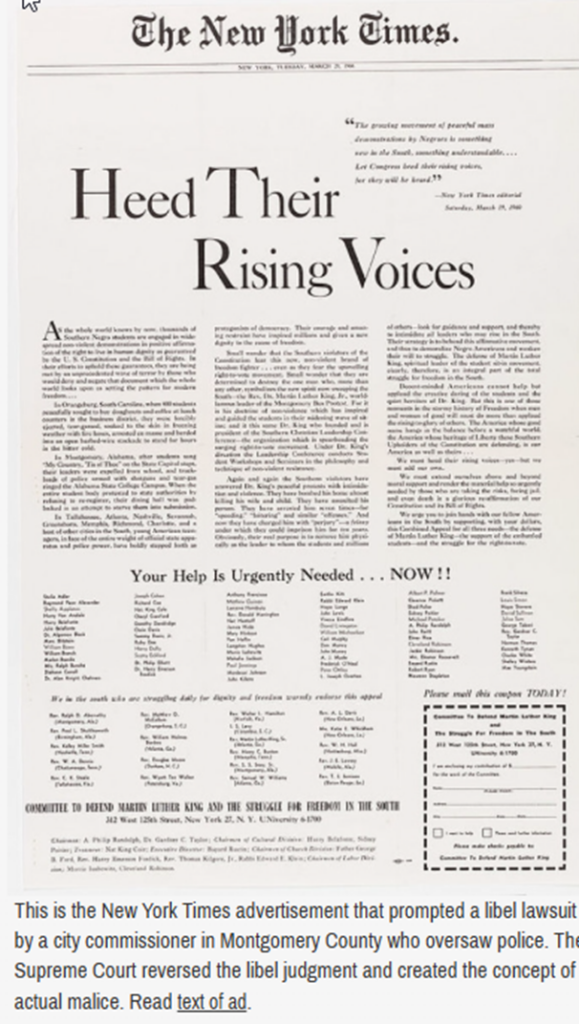
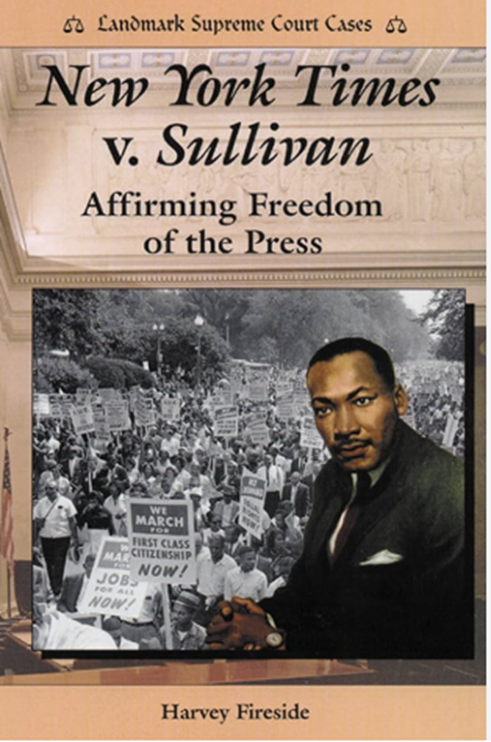
However, there needs to be accountability. While the First Amendment guarantees freedom of speech and freedom of press, reporters and news outlets should confirm the validity of all information prior to the publication. In the case Gertz v. Robert Welch, Inc Elmer Gertz, a lawyer, was falsely accused by a publication, American Opinion, of being part of a communist conspiracy. American Opinion and the publisher, Robert Welch, Inc. argued that Gertz is a public figure and must prove “actual malice” showing that American Opinion had a reckless disregard for the truth. American Opinion and Robert Welch Inc argued that precedent was set 14 years earlier in the case, New York Times Co. v. Sullivan. In this case, L.B. Sullivan, an Alabama public figure, who supervised the local police, sued The New York Times over an advertisement “Heed Their Rising Voices.” The New York Times criticized police actions against civil rights activists. Sullivan claimed that the ad, which contained some inaccuracies, defamed him by implying misconduct under his supervision. While the advertisement did not mention Mr. Sullivan’s name, an Alabama court ruled in his favor, awarding him $500,000 in damages. The case was later overturned by the U.S. Supreme Court. The New York Times argued that public officials must meet a higher standard of proof in defamation cases, requiring them to show “actual malice.” The New York Times argued that defamation lawsuits could be used to weaken accountability. By overturning the decision, the Supreme Court felt that the reporters and news outlets could continue as a check on government abuse and misuse of power.
In the case Gertz v. Robert Welch the Supreme Court, ruled in favor of Gertz. The Supreme Court felt that private individuals should not be treated the same as public figures and needed more protection. This court decision helped differentiate between public figures and private individuals. It limited the burden of proof for individuals and allowed individuals to seek damages for defamation.
As discussed, the First Amendment should not be used as shield by reporters and news outlets. It should not protect false reporting made with malicious intent or reckless disregard for the truth. The two cases mentioned show that the Court recognized the need to balance the protection of individuals versus the freedom of the press to report.
The First Amendment should not be used as a shield when reporters breach confidentiality agreements or use illegal activity to obtain information.
Is the weaponized defamation lawsuits against members of the media concerning? What are some counterarguments that a plaintiff would want to address in bringing a defamation suit?
I do not believe the weaponized defamation lawsuits against members of the media is a threat to freedom of speech and freedom of expression. I believe that there is a fine line between an individual and a public figure. I believe that all reporters and news outlets need to act responsibility and check sources. I feel the main question that should be answered is if the weaponized defamation lawsuit is an attempt to limit criticism or is it credible and reliable.
Counterarguments that a plaintiff would want to address in bringing a defamation lawsuit is whether the information published was intentionally harmful and false. Were there numerous sources? Did the reporter check their sources? What damages resulted from the publication to the person or company’s reputation?
In summary, there needs to be a balance between protecting individuals while providing the press with their freedom of speech and press.
Do anti-SLAPP Statutes Help Us?
Anti-SLAPP (Strategic Lawsuit Against Public Participation) statutes help protect reporters and news outlets from lawsuits that try to limit freedom of speech and press. The anti-SLAPP statutes allow news outlets to try and dismiss unsupported claims early so that they can avoid costly defense and publish information without the fear of retaliation.
An example of a pre anti-SLAPP statute is Grosjean v. American Press Co.. In this case, the Governor of Louisiana, Huey Long, imposed a tax on newspapers that were critical of his administration. The news outlets felt that Governor Long was in violation of their freedom of speech and press. The Supreme Court agreed that the tax was a violation of the First Amendment. The Supreme Court ruling provided precedence that governments cannot use economic penalties such as taxes to restrict freedom of speech and press. The anti-SLAPP laws help prevent future government actions from violating freedom of speech and press.
Some people believe that anti-SLAPP statutes cam be misused. They believe that legitimate claims of defamation or harm are cancelled before being reviewed. This could provide news outlets with too much power and not enough control. It is important that all lawsuits be reviewed for credibility.
Conclusion
The First Amendment is an important freedom. It guarantees freedom of speech and press. It allows reporters and news outlets to fulfill their roles and report honestly. However, this right is not absolute. It does not cover malicious and fraudulent reporting. Weaponized defamation lawsuits against the media highlight the balance between protecting freedom of speech and press while ensuring accountability. While these lawsuits pose significant challenges, anti-SLAPP statutes provide an effective option, safeguarding reporters from frivolous lawsuits intended to limit their freedom speech and press.
Landmark cases like New York Times v. Sullivan and New York Times v. Washington Post v. United States help keep controls on both freedom of speech and press while protecting individual’s rights over unsupported and false reporting. As we continue growing with digital media, there will be new lawsuits and case decisions redefining acceptable behavior and protocols.
References
Anderson, David A. Rethinking Defamation. Arizona Law Review, Vol 48 No 4, 2006. chrome-extension://efaidnbmnnnibpcajpcglclefindmkaj/https://www.arizonalawreview.org/pdf/48-4/48arizlrev1047.pdf
Cornell Law School. https://www.law.cornell.edu/wex/first_amendment#:~:text=Generally%2C%20a%20person%20cannot%20be,afforded%20to%20citizens%20in%20general.
Gertz v. Robert Welch, Inc., 418 U.S. 323, 94 S.Ct. 2997, 41 L.Ed.2d. 789 (1974). https://www.courtlistener.com/opinion/109091/gertz-v-robert-welch-inc/?court_iasd=on&page=2
Grosjean v. American Press Co., 297 U.S. 233 (1936). https://supreme.justia.com/cases/federal/us/297/233/
Iowa State University. https://freespeech.iastate.edu/faq#:~:text=Freedom%20of%20speech%20is%20the,or%20punishment%20from%20the%20government.
Levi, Lili. The Weaponized Lawsuit Against the Media: Litigation Funding as a New Threat to Journalism. University of Miami School of Law, 2017. chrome-extension://efaidnbmnnnibpcajpcglclefindmkaj/https://repository.law.miami.edu/cgi/viewcontent.cgi?article=1382&context=fac_articles
New York Times v. Sullivan, 376 U.S. 254 84 S.Ct. 710, 11 L.Ed.2d. 686 (1964). https://www.courtlistener.com/opinion/106761/new-york-times-co-v-sullivan/
New York Times v. Washington Post v. US, 403 U.S. 713 91 S.Ct. 2140, 29 L.Ed.2d 822 (1971). https://www.law.cornell.edu/supremecourt/text/403/713
Palin v. New York Times, No. 17-3801-cv, 2nd Cir., 2019. https://law.justia.com/cases/federal/appellate-courts/ca2/17-3801/17-3801-2019-08-06.html
Reporters Committee for Freedom of the Press. Understanding Anti-SLAPP Laws and Overview of Anti-SLAPP Laws. https://www.rcfp.org/resources/anti-slapp-laws/ United States Constitution and the Bill of Rights https://constitution.congress.gov/constitution/amendment-1/
United States Constitution and the Bill of Rights https://constitution.congress.gov/constitution/amendment-1/